Embryo Storage Lara
Take the Next Step With Individualised Fertility Care
For many people, fertility treatments often feel overwhelming and costly. This is where embryo freezing is usually used as a fertility preservation method, as it offers additional flexibility in fertility treatments and preserving your options.
At Surfcoast Fertility, we appreciate that fertility decisions may be an emotional experience, which is why we deliver evidence-based, patient-centred care designed around your individual needs.

An Overview of Embryo Freezing
As part of the IVF process, multiple embryos are created and allowed to develop for five to six days after fertilisation. Following this development period, the most suitable embryo is identified and selected for transfer.
Remaining embryos may be frozen for potential use in future treatment cycles. This is a common aspect of the IVF process and may allow further treatment to proceed without the need for additional ovarian stimulation.
Potential Benefits of Embryo Freezing
Reliable Storage
Excess embryos from an IVF cycle may be securely stored for up to five years in Victoria, with extensions available with approval.
Maintained Potential
Frozen embryos maintain the potential they held at the point of freezing, rather than reflecting the woman’s current age.
Pregnancy Rates
At Surfcoast Fertility, the pregnancy rates associated with frozen embryos are often on par with, or occasionally higher than, those recorded for fresh embryo transfers.
Duostim Options
Duostim may be an option for women looking to produce multiple embryos within a shorter period of time.

Considering fertility treatment?
Our team is available to support you throughout your embryo freezing journey.
About the Embryo Freezing Process
1. Sample Collection
During the IVF cycle, eggs and sperm are collected as part of your treatment plan.
2. Embryo Fertilisation
After collection, the eggs are fertilised with sperm and permitted to develop into embryos. A fresh embryo may be selected for transfer, while any remaining embryos may be frozen for possible future use.
3. Vitrification
Before freezing, any water in the embryo is removed and replaced with a protective fluid called cryoprotectant. This helps prevent ice from damaging the embryo.
4. Freezing
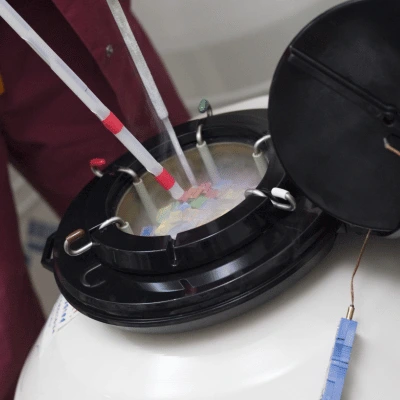
Once prepared, the embryos are frozen in liquid nitrogen at -196 °C and stored safely until required for future treatment cycles.

Answering Your Embryo Freezing Questions
Who may benefit from embryo freezing?
Embryo freezing may be worth considering for several reasons. In many cases, it may be recommended if you are:
- Undertaking IVF
- Undergoing preimplantation genetic testing (PGT)
- Undergoing hormone therapy
- Preparing for cancer treatment
- Planning gender affirmation surgery
- Seeking to reduce the risk of ovarian hyperstimulation syndrome
What happens when frozen embryos are thawed and transferred?
When ovulation occurs, or once the uterus has been appropriately prepared, frozen embryos are gradually thawed. One or more thawed embryos may then be placed into the uterus during a frozen embryo transfer (FET). After the transfer, we monitor progress to assess whether a pregnancy has been achieved.
What are the costs involved in freezing embryos?
There are a number of costs to take into account when considering embryo freezing. Hormone treatments, egg harvesting, embryo culture, freezing, and storage may all factor into the overall cost. If you have any concerns about costs, please feel free to contact our team or visit our costs page.
What is the likelihood of pregnancy following a frozen embryo transfer?
The chance of pregnancy can vary from person to person. One factor that may contribute is the woman’s age at the time of egg collection, as eggs collected at a younger age are often more viable.
What proportion of frozen embryos survive thawing?
In the majority of cases, more than 95% of embryos survive the thawing process.
Why Choose Surfcoast Fertility

Guided by Experience
Our team brings over 20 years of experience to providing compassionate, evidence-based care in support of your fertility planning.

Supportive Explanations
Because fertility decisions are so important, we take care to explain each step clearly, ensuring you feel informed and supported at every stage of your journey.

Care Close to Home
Our clinic welcomes patients weekdays between 9 am and 5 pm, and we take pride in offering accessible, local fertility care to those in the Geelong community.
Start the Next Step of Your Fertility Journey
If you’re considering fertility treatment, embryo freezing may form an important part of your care plan. At Surfcoast Fertility, we only use established clinical methods to support your fertility journey. If you have any questions, you’re always welcome to speak with our team or book an appointment.