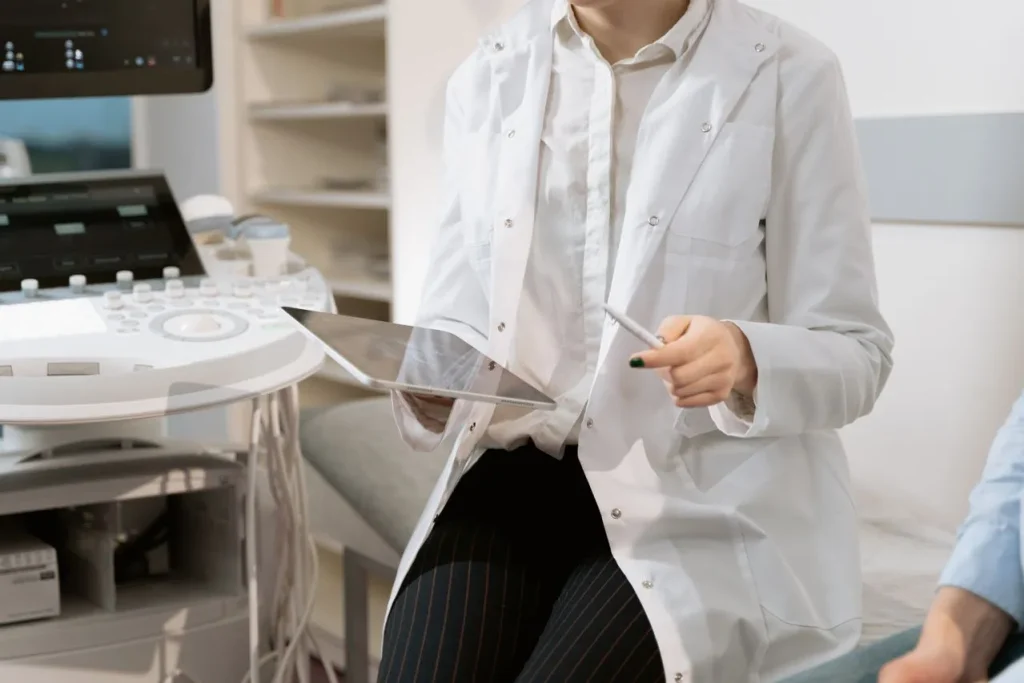
Starting an IVF journey raises a lot of questions, and one of the most common is simply: what actually happens, and in what order? The process involves a carefully coordinated series of stages that unfold over several weeks, each one building on the last.
What follows is a general overview of the twelve stages involved in a typical IVF cycle.
For personalised advice, contact our team at Surfcoast Fertility today.
How Many Stages of IVF are There?
A standard IVF cycle may involve around twelve stages, beginning with your initial consultation and concluding with a pregnancy blood test approximately two weeks after embryo transfer.
While the number of steps may seem large at first, it helps to think of them as falling across three broader phases:
- Preparation and assessment (stages one to three)
- The active treatment cycle (stages four to nine)
- Transfer and outcome (stages ten to twelve).
Stage 1: Your Initial Fertility Specialist Consultation
The process begins with a consultation with a fertility specialist, which may take place in person or via telehealth.
This is an opportunity to review your medical and reproductive history, discuss any previous fertility challenges, and understand what investigations may be needed before treatment starts.
For many people, this is also simply a chance to ask questions and begin to feel more confident about what the process involves.
Stage 2: Pre-Treatment Tests and Preparation
Before any medications are prescribed, a range of baseline tests will typically be conducted. These may include blood tests to assess hormone levels, an ultrasound to evaluate the ovaries and uterine cavity, and a semen analysis if using a partner’s sperm.
At this stage, the clinical team gets a detailed picture of your individual circumstances so that treatment is tailored appropriately.
Stage 3: Your Personal Treatment Plan
Once the results are reviewed, your fertility specialist will prescribe a treatment regimen specific to your situation.
This plan outlines the medications you will take, the doses involved, and the timing of each phase. No two plans are identical, which is why the assessment phase is so important before this step is reached.
Stage 4: Ovarian Stimulation With FSH Injections
During a natural cycle, the body typically produces just one mature egg.
Throughout the stages of IVF, the aim is to encourage the ovaries to develop multiple follicles, each containing a potential egg, to give the best opportunity for creating healthy embryos.
This is achieved through daily self-administered injections of follicle-stimulating hormone (FSH), usually given into the lower abdomen over a period of around nine to fourteen days.
Additional medications may also be prescribed to prevent premature ovulation during this phase. Most people find the injections manageable once they have been properly instructed, and the clinical team will guide you through the technique.
Stage 5: Ultrasound Monitoring and Follicle Growth
Throughout the stimulation phase, you will attend monitoring appointments that involve blood tests and vaginal ultrasounds. These allow the clinical team to assess how your ovaries are responding, track the growth and size of developing follicles, and adjust your medication dose if needed.
This monitoring is what allows the treatment to be personalised to your body’s response in real time.
Stage 6: The Trigger Injection
When your follicles reach the appropriate size, your fertility nurse will advise you on the exact time to administer a trigger injection. This injection, typically containing human chorionic gonadotrophin (hCG) or a similar hormone, prompts the eggs to undergo their final maturation process.
Stage 7: Semen Collection or Donor Sperm Preparation
On the day of egg collection, a semen sample is provided by the partner, or donor sperm is prepared in the laboratory. The sample is processed to isolate the highest quality sperm for use in fertilisation.
If surgical sperm retrieval is required due to a male factor condition, this will have been arranged in advance with the clinical team.
Stage 8: Egg Collection
Egg collection, sometimes called egg retrieval or egg pick-up (EPU), is a day procedure performed under sedation. Using ultrasound guidance, a fine needle is passed through the wall of the vagina and into each follicle to retrieve the fluid containing the eggs.
The procedure typically takes around 20 to 30 minutes, and most people are able to return home on the same day. The retrieved eggs are immediately passed to the embryology team in the laboratory.
Stage 9: Insemination, Fertilisation, and Embryo Culture
Once the eggs are collected, they are combined with the prepared sperm in the laboratory, either through conventional insemination (placing eggs and sperm together in a culture dish) or through a technique called Intracytoplasmic Sperm Injection (ICSI), where a single sperm is injected directly into an egg.
The following day, the embryologist will check which eggs have been fertilised. Fertilised eggs are then cultured in a controlled environment for approximately five days, during which they develop and divide.
By around day five, the most developed embryos will have reached what is known as the blastocyst stage, which is the optimal point for embryo transfer or freezing.
Stage 10: Embryo Transfer
This is a straightforward procedure that does not require sedation; a thin, flexible catheter is passed through the cervix and into the uterus, and the selected embryo is gently released into the uterine cavity under ultrasound guidance.
The highest quality embryo is transferred into the uterus through a very fine catheter passed through the cervix, in a procedure similar to a cervical screening. Generally, a single embryo is transferred to reduce the risk of multiple pregnancy, though this depends on individual clinical circumstances.
The procedure takes only a few minutes, and most people return to their normal activities the same day.
Stage 11: Embryo Freezing
If additional viable embryos have developed during the culture period, these may be suitable for freezing, a process called vitrification. Frozen embryos can be stored and used in future cycles, meaning that if the first transfer is unsuccessful, further attempts may be possible.
Not all embryos will meet the criteria for freezing, as those showing signs of abnormal development or significant cell fragmentation are generally not suitable.
Stage 12: Pregnancy Testing
Approximately two weeks after the embryo transfer, a blood test is performed to determine whether the transferred embryo has implanted and whether a pregnancy has been established.
This two-week waiting period is often the most emotionally challenging part of the process. Whatever the result, the clinical team will discuss the outcome with you and talk through the appropriate next steps.
What to Keep in Mind Throughout the Process
A full IVF cycle, from stimulation through to pregnancy testing, typically takes around four to six weeks, though individual timelines will vary.
Risk disclosure is an important part of beginning any fertility treatment. Beyond OHSS, risks associated with IVF may include the possibility that a cycle does not result in embryos suitable for transfer, that a transfer does not result in pregnancy, and in the case of multiple embryo transfers, a small increased risk of multiple pregnancy.
Speak to us to get started
If you are based in Geelong, Warrnambool, or the surrounding region and would like to know more about what the different stages of IVF are and what it may look like for your circumstances, Surfcoast Fertility here to support you.
Our team is available Monday to Friday, 9 AM to 5 PM, and appointments may be held in person or via telehealth.